Newsletter Subscribe
Enter your email address below and subscribe to our newsletter

All voices matter
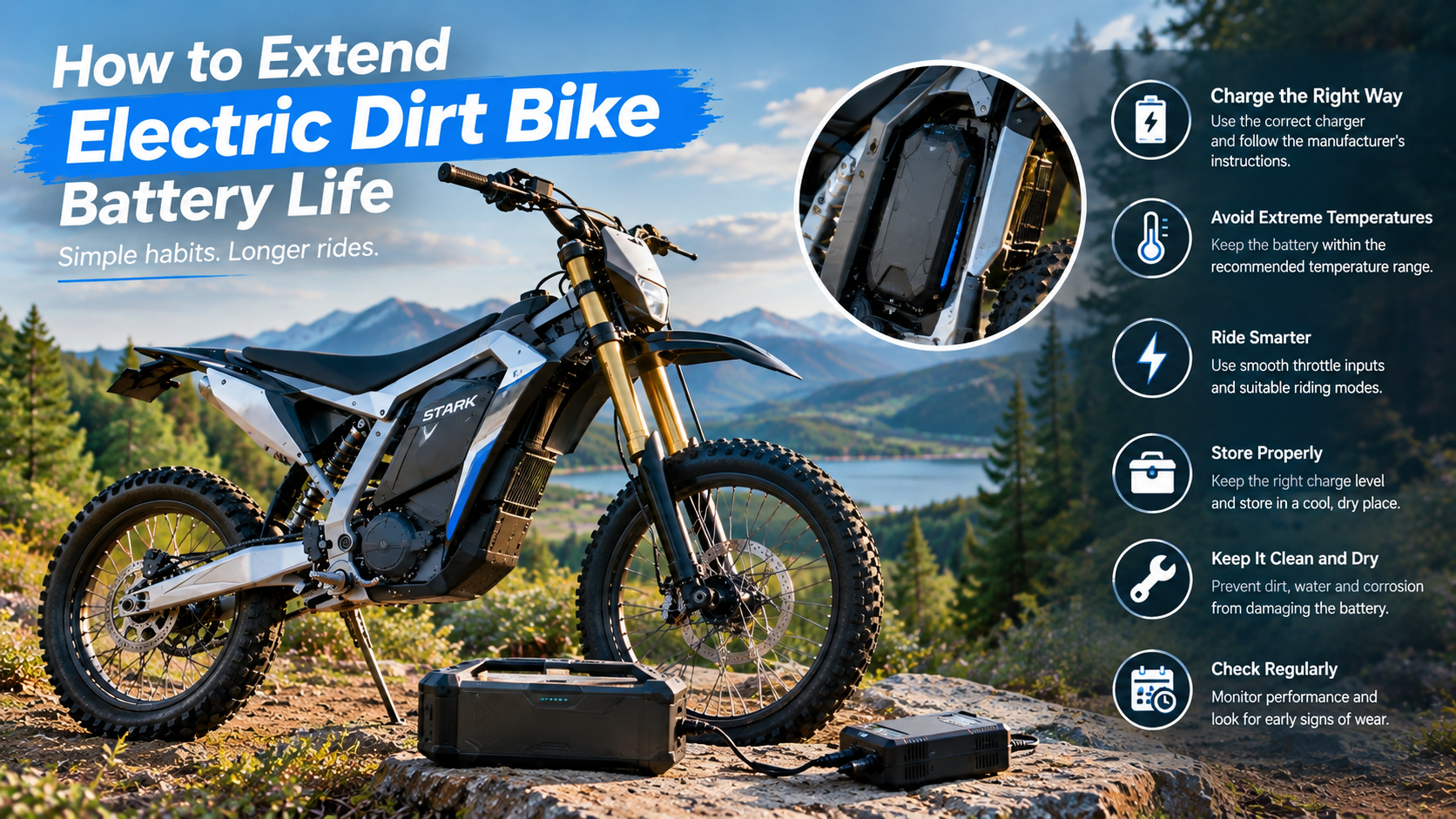
Electric dirt bikes offer instant torque, quiet operation, and a riding experience that requires less routine powertrain maintenance than traditional gas-powered motorcycles. However, the battery is one of the most important components to protect. Replacing a battery can be expensive, and poor charging or storage habits may cause it to lose capacity sooner than expected.
The good news is that proper battery care can help preserve performance, maintain riding range, and reduce long-term ownership costs.
Whether you ride on weekends, explore technical trails, or use your electric dirt bike regularly, understanding how to care for its battery is essential. In this guide, we explain ten practical ways to extend electric dirt bike battery life, identify common mistakes, and prepare your bike for long-term storage.
Using the correct charger is one of the most important steps in protecting an electric dirt bike battery.
Different battery systems have specific voltage requirements, charging profiles, and communication systems. A charger that physically fits the charging port is not necessarily compatible with the battery.
Always use the charger supplied with the bike or a replacement explicitly approved by the manufacturer.
An incompatible charger can cause charging problems, damage battery components, or create electrical and fire hazards. Avoid modifying the charging system or using an unapproved charger simply because it promises faster charging.
Before charging, check the charger cable, connector, and housing for visible damage. If anything looks damaged, stop using the equipment and arrange an appropriate inspection.
Practical tip: Keep the original charger manual with your motorcycle documentation so you can easily check the correct charging procedure and temperature limits.
Lithium-ion batteries gradually age over time, and remaining at a very high state of charge for extended periods can accelerate degradation in many battery chemistries.
This does not mean you should avoid fully charging your electric dirt bike before a ride. If the manufacturer recommends a full charge for normal use, follow that guidance.
The important distinction is between charging for an upcoming ride and leaving the battery at 100% for days or weeks when the bike will not be used.
For longer storage periods, follow the manufacturer’s recommended storage charge level. Some battery systems specify a partial charge, while others use different procedures.
A simple routine can help:
Following model-specific guidance is more reliable than applying a universal charging rule to every battery.
Repeatedly discharging a battery to its lowest permitted level may place more stress on the cells than using a shallower portion of the battery’s capacity.
Although modern battery management systems usually include protection against excessive discharge, these protections are not a reason to deliberately run the battery flat after every ride.
Try to plan your rides so you can return with a reasonable amount of charge remaining. If your bike displays a low-battery warning, pay attention to it and follow the manufacturer’s instructions.
Deep discharge is particularly worth avoiding during storage. A battery left nearly empty for a long period may eventually fall below its permitted voltage range, potentially preventing normal charging.
Remember that a battery percentage is an estimate, not always a perfectly precise measurement of remaining energy.
Heat is one of the major factors that can accelerate lithium-ion battery aging.
Electric dirt bikes may generate substantial heat during demanding rides, especially when climbing steep hills, accelerating repeatedly, or riding in hot weather. High ambient temperatures and poor ventilation can add to the problem.
To help protect your battery:
Do not place an unusually hot battery in a refrigerator, freezer, or other improvised cooling setup. Sudden temperature changes and condensation may create additional risks.
If the battery becomes abnormally hot, swells, leaks, emits smoke, or produces an unusual odor, stop using and charging it. Keep away from the battery and seek qualified assistance.
Cold weather can affect battery performance even when the battery is in good condition.
In low temperatures, a lithium-ion battery may temporarily deliver less usable energy, which can reduce riding range. Charging below the battery’s permitted temperature can also cause damage.
If you ride during winter, check the battery manufacturer’s operating and charging temperature limits.
| Cold-Weather Situation | Potential Effect | Recommended Practice |
|---|---|---|
| Riding in cold conditions | Reduced available power or range | Plan shorter rides if necessary |
| Storing the bike in an unheated location | Battery temperature may fall outside the recommended range | Follow the manufacturer’s storage guidance |
| Charging a very cold battery | Potential battery damage on some systems | Wait until it reaches the permitted charging temperature |
| Moving the bike from cold outdoors into a warm space | Condensation may develop | Follow the manufacturer’s guidance before charging |
| Leaving the battery unused for months | Gradual self-discharge may continue | Check the battery periodically if instructed |
Do not assume that every electric dirt bike supports charging at freezing temperatures. Some systems include temperature monitoring or heating features, while others do not.
Battery life per charge depends heavily on how you ride.
Repeated hard acceleration, high-speed riding, steep climbs, and aggressive riding on soft terrain can consume significantly more energy than steady riding at moderate speeds.
Although these riding habits do not necessarily mean the battery will fail prematurely, high power demand can increase heat and make each riding session use more of the battery’s available capacity.
To improve efficiency:
You do not need to sacrifice the fun of riding. The goal is to match the bike’s power output to the conditions rather than using maximum power at every opportunity.
Long-term storage requires more attention than simply parking the motorcycle and leaving it untouched.
If you will not ride for several weeks or months, prepare the battery according to the manufacturer’s instructions. This is particularly important during winter, extended travel, or the off-season.
A practical storage checklist includes:
Avoid storing the battery fully discharged or leaving it connected to an unapproved charger for months.
If the battery is removable, use only the manufacturer’s approved removal and storage procedure. Some integrated battery systems should be serviced only by qualified technicians.
Off-road riding exposes electric dirt bikes to mud, dust, water, and vibration. These conditions make regular inspection especially important.
A clean battery housing and properly maintained electrical connections help reduce the likelihood of avoidable electrical problems.
After riding, inspect the bike for:
Use only cleaning methods permitted by the manufacturer. Avoid directing high-pressure water at the battery compartment, charging port, electrical connectors, or other sensitive components.
Never connect a charger when the charging port or connector is wet. Allow components to dry fully according to the manufacturer’s instructions before charging.
If you notice corrosion, damaged wiring, or water inside the battery enclosure, arrange a professional inspection rather than attempting an improvised repair.
Rider weight, additional equipment, and terrain all affect energy consumption.
A heavier combined load requires more energy during acceleration and climbing. Similarly, riding through deep sand, thick mud, or steep technical sections can demand more power than riding on firm, relatively flat trails.
These conditions mainly affect riding range, but repeated high-power use can also increase battery temperature and operating stress.
To make the most of your battery:
Tire pressure should always be adjusted within the recommended range for the motorcycle and riding conditions. Do not inflate tires beyond their permitted limits in an attempt to improve battery efficiency.
Monitoring battery performance can help you identify changes before they become major problems.
A battery gradually loses capacity as it ages, but a sudden reduction in range may indicate something other than normal degradation. Tire pressure, temperature, riding style, charger problems, and electrical faults can all affect performance.
Keep a simple record of your usual rides.
| What to Monitor | Why It Matters | What to Look For |
|---|---|---|
| Riding time per charge | Helps track usable energy over time | Consistent reductions under similar conditions |
| Battery temperature | Helps identify excessive heat | Repeated temperature warnings |
| Charging behavior | Helps identify potential charging issues | Unusual interruptions or error messages |
| Battery condition | Helps identify physical damage | Swelling, cracks, leaks, or damaged connectors |
| Error messages | May reveal electrical or battery-system faults | Repeated or unexplained warnings |
For a fair comparison, try to evaluate performance under similar conditions. A shorter ride on a cold day does not automatically mean the battery has deteriorated.
If you notice a sudden range reduction, repeated charging errors, or unexpected power loss, consult the owner’s manual or an authorized service provider.
Even riders who maintain their motorcycles carefully can develop charging habits that are not ideal for long-term battery health.
| Common Mistake | Why It Can Be a Problem | Better Approach |
|---|---|---|
| Using an unapproved charger | May have incompatible electrical specifications | Use an approved charger |
| Leaving the battery empty during storage | Self-discharge may push the battery below safe limits | Follow storage charge recommendations |
| Keeping it fully charged for extended storage | May accelerate aging in many lithium-ion systems | Use the recommended storage charge |
| Charging outside permitted temperatures | May damage battery cells | Follow temperature limits |
| Ignoring overheating warnings | May increase the risk of battery damage | Stop and investigate the warning |
| Washing the bike with high-pressure water | May force water into sensitive components | Use approved cleaning methods |
| Opening a sealed battery pack | Can cause electrical, fire, or chemical hazards | Use qualified battery service |
The best battery care routine is consistent, straightforward, and based on the specific motorcycle’s documentation.
Battery maintenance does not stop a lithium-ion battery from aging. All rechargeable batteries gradually lose capacity with time and use.
However, avoiding unnecessary stress can help preserve usable capacity and may reduce the chance of premature replacement.
The potential financial benefit depends on several factors:
For example, a rider who uses an electric dirt bike only occasionally may experience a different aging pattern from someone who rides demanding trails several times a week.
Rather than assuming that a particular routine will add a fixed number of years to battery life, focus on following the manufacturer’s recommendations and avoiding known sources of unnecessary battery stress.
You should follow the manufacturer’s charging recommendations. You do not necessarily need to recharge after every short ride, but you should avoid leaving the battery nearly empty for an extended period. Charge it appropriately for your next ride and storage plans.
Not necessarily. A full charge may be appropriate before a ride, depending on the bike’s design. The concern is often leaving a lithium-ion battery fully charged for an extended period when it is not needed. Follow the manufacturer’s instructions.
Check the owner’s manual before doing so. Some systems include charging protections, but unattended charging should never be assumed safe for every model. Use the approved charger in a suitable location and follow all manufacturer safety instructions.
High charging rates can increase battery stress and heat, depending on the battery design. If fast charging is supported, use only the approved charging equipment and follow the manufacturer’s recommendations.
Inspect the battery and electrical connections regularly, especially after demanding off-road rides. Follow the manufacturer’s recommended maintenance schedule and storage-check procedure.
Eco mode can reduce energy consumption by limiting power output or adjusting the bike’s response, depending on the model. It can often help extend riding time per charge. However, its effect on long-term battery lifespan depends on temperature, power demand, charging habits, and battery design.
Only if the manufacturer recommends or permits it. Some batteries are designed to be removable, while others are integrated into the motorcycle. Always follow the specified removal and storage procedure.
Consider a professional battery assessment if the bike consistently provides much less range under comparable conditions, displays repeated battery warnings, or develops charging problems. Physical swelling, leakage, smoke, or unusual heat requires immediate discontinuation of use and appropriate safety assistance.
Extending electric dirt bike battery life is mainly about reducing unnecessary stress and following the right maintenance routine.
Use the approved charger, avoid prolonged storage at extreme charge levels, protect the battery from excessive heat and inappropriate cold-weather charging, and store the motorcycle correctly when it is not in use. Smooth riding and regular inspections can also help you get more usable range from every charge.
Most importantly, remember that every battery system has its own requirements. Check your owner’s manual for the correct charging limits, temperature range, storage procedure, and service recommendations.
A well-maintained battery will still age naturally, but good habits can help you protect your investment and enjoy more consistent performance over the life of your electric dirt bike.
SEO Title: How to Extend Electric Dirt Bike Battery Life: 10 Tips
Meta Description: Learn how to extend electric dirt bike battery life with practical charging, storage, temperature, riding, and maintenance tips.
URL Slug: how-to-extend-electric-dirt-bike-battery-life
Primary Keyword: how to extend electric dirt bike battery life
Secondary Keywords:
Link this article to related content on your website:
Editorial note: Battery chemistry, charging limits, storage requirements, and warranty terms vary by model. Verify model-specific recommendations against the manufacturer’s current documentation before publishing any exact charging percentages or temperature limits.