Newsletter Subscribe
Enter your email address below and subscribe to our newsletter

All voices matter
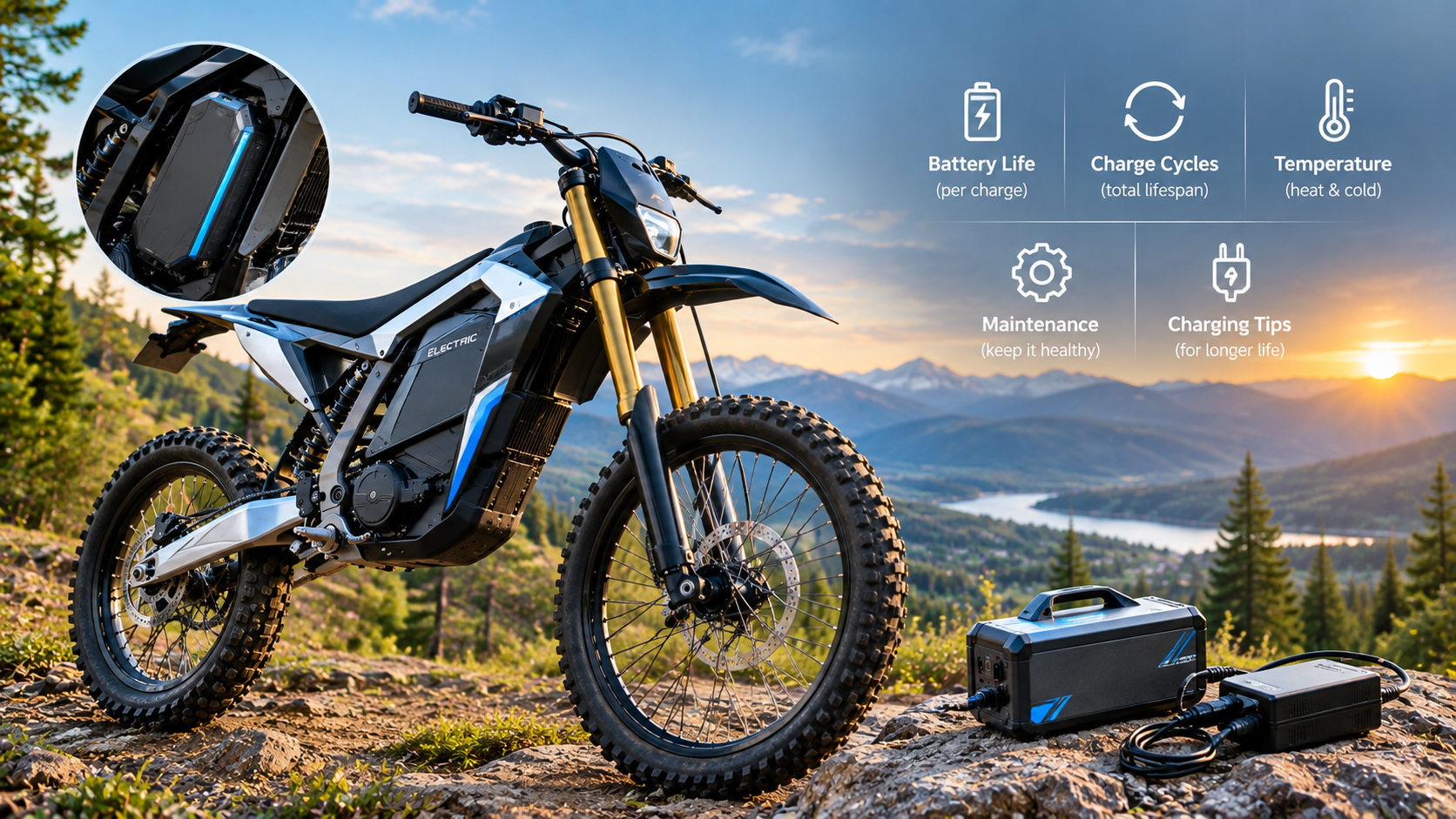
Electric dirt bikes are becoming increasingly popular among off-road riders because they offer quiet operation, instant torque, and relatively simple maintenance. However, one question often comes up before buying an electric dirt bike: How long does the battery actually last?
The answer depends on what you mean by battery life. A fully charged battery may power your bike for a few hours of riding, while the battery itself may remain usable for several years before its capacity noticeably declines.
In this guide, we explain how long electric dirt bike batteries typically last, what affects their lifespan, how to recognize battery degradation, and what you can do to extend battery life. Whether you are a beginner comparing electric and gas dirt bikes or an experienced rider looking to protect your investment, understanding battery performance can help you make a more informed decision.
Electric dirt bike battery life can be measured in two different ways: riding time per charge and overall battery lifespan.
Riding time describes how long a bike can operate before its battery needs recharging. Overall lifespan describes how many years the battery may remain useful before its capacity drops enough to affect your riding experience.
Many electric dirt bikes provide approximately one to several hours of riding per charge. However, actual riding time can vary significantly depending on battery capacity, motor power, terrain, rider weight, speed, and riding style.
| Riding Conditions | Expected Battery Impact | What to Expect |
|---|---|---|
| Slow trail riding | Lower to moderate energy use | Potentially longer riding sessions |
| Technical off-road riding | Moderate to high energy use | More frequent power demands |
| Aggressive acceleration | High energy use | Shorter riding time |
| Steep hill climbing | High energy use | Faster battery depletion |
| High-speed riding | Moderate to high energy use | Reduced riding time |
| Casual riding with frequent breaks | Variable | Actual ride time depends on how often the motor is used |
These are general comparisons rather than guaranteed riding-time estimates. Two riders using the same electric dirt bike may experience very different results.
The lifespan of an electric dirt bike battery depends on its chemistry, quality, operating temperature, charging habits, and frequency of use.
Many modern lithium-ion battery packs are designed to withstand hundreds of charge cycles. Under suitable conditions, a battery may remain useful for several years, although its range and performance can gradually decline.
For example, a battery that originally provides 100% of its usable capacity may eventually retain only around 80%. This does not necessarily mean the battery has stopped working, but it may provide less riding time than when it was new.
There is no universal replacement date for every electric dirt bike battery. The manufacturer’s specifications and the rider’s actual usage are more useful than a single lifespan estimate.
A battery charge cycle is commonly understood as the cumulative use of an amount of energy equivalent to 100% of the battery’s capacity.
This does not mean every time you connect the charger, you have completed one full cycle.
For example, if you use approximately 50% of the battery’s capacity and recharge it, then later use another 50%, the combined usage is roughly equivalent to one full cycle.
Understanding charge cycles helps explain why battery lifespan cannot be measured simply by counting how many times the charger has been plugged in.
Several factors influence how many useful cycles a battery can deliver:
A battery’s rated cycle life is not a guarantee. Real-world performance depends on how the complete battery pack is designed and used.
If you want your electric dirt bike battery to last longer, understanding the main causes of battery wear is essential.
Battery quality is one of the most important factors in long-term performance.
A well-designed battery pack uses suitable cells, reliable electrical connections, effective thermal management, and a battery management system. These components work together to protect the battery during charging and riding.
Lithium-ion batteries are widely used in electric dirt bikes because they offer a useful balance of energy density, weight, and power output. However, not all lithium-ion batteries have the same chemistry, construction, or expected lifespan.
When comparing electric dirt bikes, look beyond the advertised battery capacity. Check whether the manufacturer provides information about battery warranty, replacement availability, and charging requirements.
Your riding style has a direct impact on how quickly the battery loses charge.
Frequent hard acceleration, repeated hill climbs, high-speed riding, and aggressive throttle use generally consume more energy than steady riding at moderate speeds.
Technical trails can also demand substantial power because riders may repeatedly accelerate out of corners, climb obstacles, and change speed.
To improve riding time, use smooth throttle inputs and select a suitable riding mode when the bike offers multiple power settings.
Riding conditions can significantly change battery consumption.
Soft sand, mud, steep slopes, and rocky terrain may require more energy than relatively flat, firm trails. Cold weather can temporarily reduce the amount of energy available from a lithium-ion battery, while excessive heat can accelerate long-term degradation.
If you regularly ride in extreme conditions, follow the manufacturer’s temperature limits for both operation and charging.
The combined weight of the rider, bike, protective equipment, and any additional cargo affects energy consumption.
Heavier loads generally require more energy during acceleration and climbing. This does not mean heavier riders cannot enjoy electric dirt bikes, but it does mean that real-world range may differ from advertised figures.
When choosing a bike, consider your weight, riding terrain, and typical session length rather than relying exclusively on laboratory or ideal-condition range estimates.
Good battery care can help preserve usable capacity and reduce the likelihood of premature replacement.
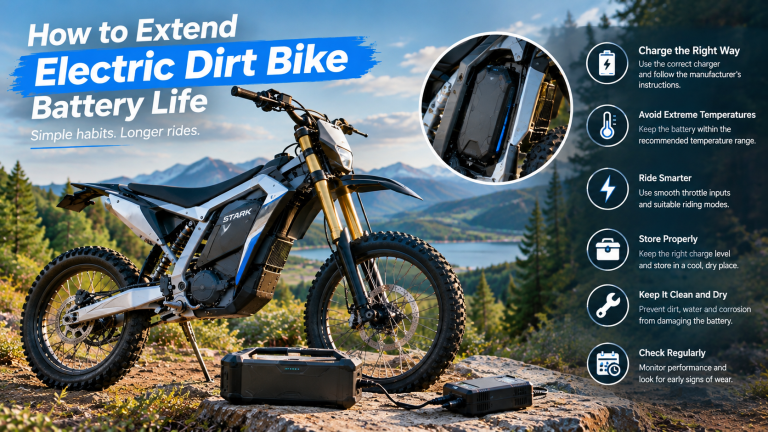
Follow the charging and storage instructions supplied by the manufacturer. For many lithium-ion batteries, avoiding prolonged storage at a completely full or nearly empty state can help reduce aging.
Some manufacturers recommend a partial charge for longer-term storage, while others specify a particular procedure for their battery systems.
Do not assume that one charging percentage is correct for every electric dirt bike. The manufacturer’s instructions should take priority.
Always use a charger approved for your specific battery system.
A charger with an incompatible voltage, connector, or charging profile can create serious safety risks. Even if a third-party charger appears to fit, that does not mean it is suitable.
Avoid modifying the charging system or bypassing the battery management system to increase charging speed.
Heat is a major contributor to battery aging. After an intensive ride, allow the battery to return to the manufacturer’s permitted charging temperature before connecting the charger if required by the manual.
Do not charge a battery that is unusually hot, visibly damaged, swollen, or showing other signs of failure.
In cold conditions, follow the manufacturer’s guidance before charging. Some battery systems prohibit charging below a specified temperature.
If you will not ride for several weeks or months, prepare the battery for storage according to the owner’s manual.
In general:
Proper storage is particularly important during winter or long breaks between riding seasons.
Intensive riding can generate heat in both the motor and battery system. If your bike displays a temperature warning or reduces power because of overheating, stop and follow the manufacturer’s cooling instructions.
Do not continue pushing the bike beyond its intended operating limits. Thermal protection is designed to help prevent damage, and bypassing it can create additional risks.
Battery degradation is usually gradual rather than sudden. Recognizing the early signs can help you decide whether the battery needs inspection or replacement.
| Warning Sign | Possible Explanation | Recommended Action |
|---|---|---|
| Shorter riding time | Reduced usable battery capacity or changing riding conditions | Compare performance under similar conditions |
| Unexpected power reduction | Battery limitations, temperature protection, or another fault | Check warnings and consult the manual |
| Longer charging time | Charger, battery, temperature, or balancing issue | Check the approved charging system |
| Battery percentage changes unexpectedly | Battery estimation or cell-performance issue | Arrange a diagnostic check |
| Battery becomes unusually hot | Possible electrical or battery fault | Stop using and charging it; seek qualified service |
| Swelling, leakage, or physical damage | Potential battery failure | Stop use and charging; follow professional safety guidance |
A shorter range does not automatically mean the battery is failing. Tire pressure, terrain, ambient temperature, rider weight, and riding style can all change energy consumption.
For a more reliable comparison, record your typical route, riding duration, battery level before and after the ride, and weather conditions. Repeating the same test occasionally can help reveal whether performance is declining.
Important safety note: If a battery becomes swollen, leaks, emits smoke, produces an unusual odor, or becomes dangerously hot, stop using it and do not attempt to open or repair the pack yourself. Keep away from the battery and seek appropriate emergency or professional assistance if necessary.
Battery replacement is an important part of the long-term ownership cost of an electric dirt bike.
The price varies considerably according to battery capacity, cell quality, voltage, manufacturer, model, and whether the replacement is an original equipment battery or an approved alternative.
Smaller electric off-road bikes may use less expensive battery packs, while high-performance adult models can require more substantial and costly replacements.
| Factor | How It Affects Replacement Cost |
|---|---|
| Battery capacity | Larger energy capacity often increases cost |
| Performance requirements | High-power battery packs may require more specialized components |
| Brand and model | Proprietary battery systems can limit replacement choices |
| Battery availability | Limited stock or discontinued models may make replacement harder |
| Warranty coverage | Eligible failures may be covered under the manufacturer’s terms |
| Labor and diagnostics | Professional installation or troubleshooting may add cost |
Rather than relying on a single price estimate, check the manufacturer’s current replacement-battery price for the exact model you intend to buy.
Before purchasing an electr